
Every other step of the process happens in offices and meeting rooms. This one happens in front of everyone you know. So here is the wedding day itself, minute by minute, in both of its formats, so that when you stand up there, nothing that happens will be happening to you for the first time.
The reassurance up front, because it’s the headline: at no point in a Catholic wedding does the non-Catholic partner profess a faith, recite a prayer alone, or perform any gesture of belief. Your speaking parts are about one subject only: the person standing opposite you.
First, the one big choice: with Mass or without
A Catholic wedding comes in two sizes. The ceremony without Mass (readings, vows, rings, blessing) runs about thirty to forty-five minutes. The Nuptial Mass wraps that same core inside a full Mass, adding the Eucharist and stretching the hour to seventy-plus minutes.
For a couple like you, the choice is mostly made already. When one partner isn’t baptized, the ceremony without Mass is the norm; when the non-Catholic partner is a baptized Christian, both forms are possible, but the shorter one is usually recommended, including by priests themselves. The reason becomes obvious at the communion moment of a Mass: half the church rises to receive, half sits wondering what to do with their hands. The form without Mass simply has no such moment. Nobody is sorted into insiders and outsiders, and the vows, not the liturgy, hold the center of the hour.
(And if you’re reading this already civilly married, planning the church wedding as a later chapter: the day itself looks the same; the road to it is shorter and has its own guide: convalidation explained.)
The ceremony without Mass, minute by minute
Minutes 0–5: Entrance. Procession in, according to whatever custom you’ve chosen; the priest greets everyone. If a big share of your guests has never seen the inside of a church, this is where a printed program earns its keep (more on that below).
Minutes 5–20: The readings. One or two Scripture readings, a psalm, a Gospel passage, and a short homily. You and your partner choose the readings in advance from an approved list, and choosing them together is one of the quietly nice parts of the preparation. The homily at a mixed wedding is typically about love and the couple, not doctrine; priests know who’s in the pews.
Minutes 20–30 (The marriage itself. The priest asks each of you the questions of intent) that you come freely, that you promise fidelity for life, that you’re open to children, with wording the celebrant adapts appropriately for a mixed couple. Then the consent: you take each other’s hand and speak the vows. Read them once and you’ll notice what they contain (faithfulness, good times and bad, sickness and health, love and honor all the days of your life) and what they don’t: not one word requiring belief. Then the rings are blessed and exchanged, and you are, at that moment, married.
Minutes 30–40: Prayers and blessing. Short intercessions (often read by family or friends), the Lord’s Prayer (you may simply stand in silence; nobody watches your lips), and the nuptial blessing over you both. Depending on your country, the registry signing happens here or after; then the final blessing and the walk out to applause.
From experience: The moment I’d worried about most (the Lord’s Prayer, everyone speaking in unison except me) lasted about twenty seconds, and precisely nobody looked at me. The moment I hadn’t prepared for at all was hearing my own voice say the vows in a full, silent church. Prepare for that one instead
If you do have a Mass: what changes
Everything above still happens, in the same order, and after the vows, the Liturgy of the Eucharist begins: the gifts, the Eucharistic prayer, communion. Two practical notes for that stretch.
You, as a non-Catholic, don’t receive communion. That’s the universal rule, not a slight, and it applies to your non-Catholic guests too. You can remain seated or, where the local practice welcomes it, come forward with arms crossed over your chest for a blessing instead. Agree with the priest beforehand which you’ll do, so the moment has a plan.
And if a Nuptial Mass will also be your first Mass ever (perhaps with your partner’s devout family watching) the full sit-stand-kneel field guide is here: surviving your first Mass.
Your part, exactly
Inventory of everything the non-Catholic partner does: answer three questions about your intent, speak the vows, exchange rings, sign where pointed. Inventory of everything you don’t do: no creed, no solo prayer, no genuflecting, no crossing yourself, no communion. When the congregation stands or sits, you follow: the same courtesy you’d show at anyone’s ceremony in any tradition. You cannot get this wrong in any way that matters.
“[✎] My most religious act of the entire wedding was standing up on time. My most difficult one was not crying during the vows. I failed only the second.”
Involving your side
A mixed wedding has a mixed guest list, and the ceremony offers real roles for your people. Most parishes welcome non-Catholic family and friends as readers for the Scripture readings and intercessions: a genuinely meaningful job, and one your bookish aunt will do beautifully. Ushers, gift bearers at a Mass, musicians where the parish’s music rules allow: all typically open. Music itself follows liturgical rules (secular songs usually live before and after the ceremony rather than inside it) so bring your wishlist to the priest early and let him sort it into “during” and “reception.”
And print a program. One folded page: order of events, when people stand and sit, a line noting that communion (if there is one) is for Catholics and everyone else is warmly welcome to remain seated. It costs nothing and quietly answers the question every non-Catholic guest is silently asking: what am I supposed to do? You, of all couples, know exactly how they feel.
Key takeaways
- Two formats: without Mass (~40 min) (the norm and usually the better fit for mixed couples) and the full Nuptial Mass (~70+ min).
- Your speaking parts, intent, vows, rings, are entirely about your marriage, not belief. There is no profession of faith anywhere in your role.
- At a Mass, non-Catholics (you and your guests) don’t receive communion. Agree the plan for that moment with the priest in advance.
- Your side can carry real roles: readings, intercessions, ushering, music within the rules.
- A one-page printed program is the cheapest kindness you can offer a mixed guest list.
IF YOU WANT TO GO DEEPER
The Non-Catholic Partner’s Wedding Kit
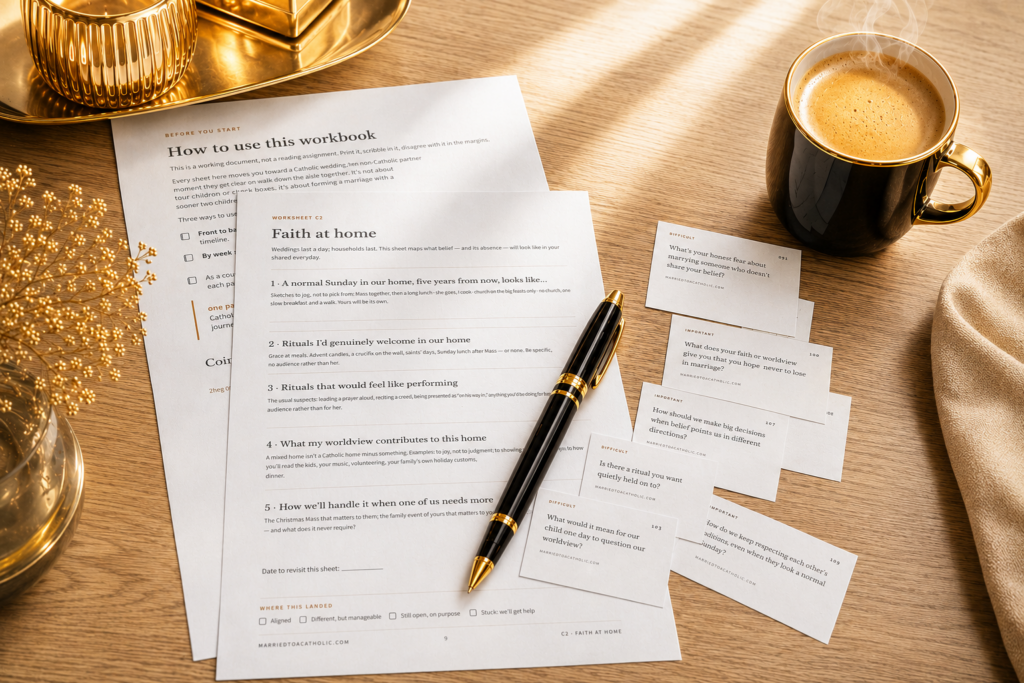
A complete step-by-step system to guide you both through Catholic wedding prep. Includes an 81-page guide, a shared workbook with practical worksheets, and 40 conversation cards.
Talk through your differences today, so you can walk down the aisle completely aligned.
One payment, including tax. 14 days, money back. Read a full chapter free.