
Of all the stations on the road to a Catholic wedding, marriage preparation is the one with the most misleading name. It sounds like catechism class: a course where you, the non-Catholic, will finally be cornered and quizzed. Having sat through it from your exact seat, let me recalibrate your expectations: it’s mostly a relationship workshop, occasionally a theology lecture, and the skill is knowing which hour is which.
What marriage prep actually is
Every couple marrying in the Church attends some form of preparation. It’s not a special hurdle invented for mixed couples. What it looks like depends entirely on the diocese and parish: a single weekend retreat, a series of evenings spread over weeks, a few sit-downs with the priest or a deacon, or meetings with a “sponsor couple”: married volunteers who’ve been assigned to talk honestly with you about married life. In many dioceses it starts with a questionnaire the two of you fill in separately (an inventory of your views on money, family, conflict, faith) whose results structure the sessions that follow.
Who runs it matters more than the format. A deacon and his wife of thirty years run a very different room than a young priest with slides. You found out which one you’re getting at the first parish visit, and if you didn’t ask, your partner can still find out with one phone call, which I recommend. Forewarned is relaxed.
What the sessions actually cover
Here’s the part nobody tells you: most of the curriculum has no denomination. Communication and how you argue. Money, who spends, who saves, who’s wrong. Families of origin and the patterns you’re each importing. Expectations about roles, work, children. If a secular therapist designed a pre-marriage course, four-fifths of it would look identical, and those four-fifths are genuinely useful to any couple honest enough to engage with them.
The remaining fifth is Catholic: a session on marriage as a sacrament (what the Church believes is happening when you marry) and a session on sexuality and family planning. That second one deserves its own honest paragraph, so it gets one below.
From experience: Our questionnaire flagged exactly one “significant disagreement”: how often to visit in-laws. Religion, the thing I’d braced for, scored as aligned, because the questions asked what we’d agreed to do, not what we each believed. The inventory measures the marriage, not the metaphysics. That’s the whole course in miniature.
The Catholic parts, honestly
The sacrament session is theology, delivered to a room where you may be the least invested listener. My advice: listen anyway, and listen as an anthropologist of your own marriage. This is the official version of what your partner’s tradition believes your wedding means. You don’t have to share the belief to want to understand it; you’re marrying someone formed by it. Nobody will ask you to affirm anything. Nodding is not a sacrament.
The sexuality and family planning session presents the Church’s teaching, typically including natural family planning, sometimes with visible earnestness. This is usually the most awkward hour for a mixed couple, not because anyone confronts you, but because you’re hearing a doctrine your household may not follow, presented as though it will. Sit through it with grace; then have your own conversation in the car, because where the two of you actually land on this is a decision for your bedroom, not the parish hall, and it’s conversation number seven on the list you should be working through anyway.
Prayer moments (an opening prayer, perhaps a closing blessing) happen in most formats. Your protocol is the same as at the wedding itself: stand when others stand, hold the respectful silence, participate in exactly nothing you’d have to fake. In several years of collecting couples’ stories, I’ve yet to hear of anyone being called on to pray solo at Pre-Cana.
Being the non-Catholic in the room
The question that actually gnaws at people: do we announce it? When the group goes around introducing themselves, do you say “and I’m not Catholic”? My answer: yes, casually, early (“I’m not Catholic myself, so some of this is new to me”) for three reasons. It costs two seconds of mild attention. It converts you from impostor to honest guest, which changes how the whole weekend feels from the inside. And it frees you to ask the genuinely useful questions (“what does that term mean?”) without performing knowledge you don’t have.
And statistically, you won’t be alone. Mixed couples are a large share of Catholic weddings; look around the room and the odds are good that another partner is doing the same quiet arithmetic you are. Sometimes the best thing you take from Pre-Cana is coffee with them.
“[✎] The priest asked the room what makes marriage hard. Twelve Catholics said things like ‘selfishness.’ I said ‘IKEA.’ It got the biggest laugh of the weekend, and nobody checked my baptism certificate on the way out.”
What you can actually get out of it
You can endure Pre-Cana, or you can strip-mine it. The structured hours on money, conflict, and family are professionally designed conversation starters that most couples never buy for themselves. Use them at face value. The questionnaire results are a map of your genuine disagreements, delivered by a neutral third party; that’s worth more than the fee. And the Catholic sessions, taken as intelligence rather than instruction, will teach you the vocabulary and logic of the world your partner grew up in, which will pay dividends at every family Christmas for the rest of your life.
The couples who get the least from marriage prep are the ones who treat it as a toll booth. Be the couple in the corner actually talking. You’re doing the hours either way.
Key takeaways
- Marriage prep is for every couple marrying in the Church. You’re not being singled out, and formats vary wildly by diocese.
- Roughly four-fifths of the content is denomination-free: communication, money, conflict, family, useful to anyone.
- The Catholic fifth (the sacrament session and the family-planning hour) asks your attention, not your assent. Listen as an anthropologist.
- Out yourself casually and early. “I’m not Catholic, some of this is new to me” turns impostor syndrome into honest curiosity.
- Treat the questionnaire and structured sessions as free couples counseling: the couples who mine it win; the couples who endure it just lose a weekend.
IF YOU WANT TO GO DEEPER
The Non-Catholic Partner’s Wedding Kit
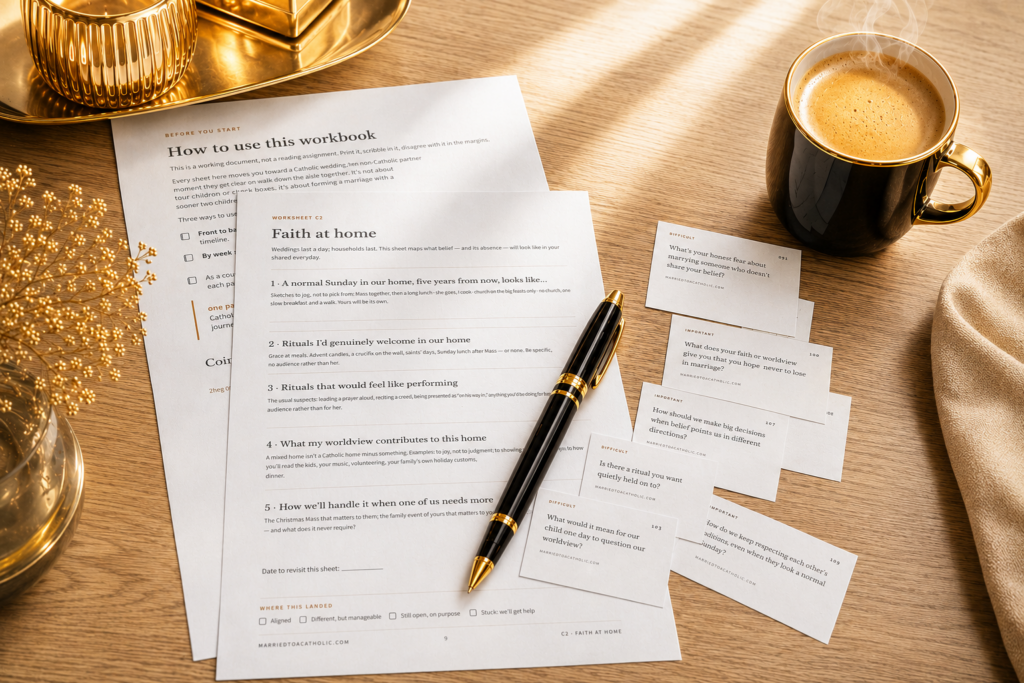
A complete step-by-step system to guide you both through Catholic wedding prep. Includes an 81-page guide, a shared workbook with practical worksheets, and 40 conversation cards.
Talk through your differences today, so you can walk down the aisle completely aligned.
One payment, including tax. 14 days, money back. Read a full chapter free.