
You’re marrying a Catholic. You’re not one. And somewhere between the proposal and the wedding day stands a process nobody has explained to you from your side of the aisle: a sequence of phone calls, meetings, forms, and one course, stretched over several months. This guide is the whole of it, in order: what happens, when it happens, what’s asked of you at each step, and which parts are easier than they sound. (Spoiler: most of them.)
Every step below links to a detailed guide of its own. Read this page first for the map; go deep only where your situation needs it.
The journey at a glance
Start to finish, the church side of your wedding takes roughly six to twelve months, not because any single step is long, but because dioceses want time between first contact and wedding day. Most ask for six months or more. The sequence is always the same: a first visit to the parish, then the paperwork (including the dispensation that makes a mixed marriage possible), then marriage preparation, then the ceremony planning, then the day itself. Two steps involve you actively; the rest involve you mostly as a friendly witness to your partner’s paperwork.
One reassurance before we start walking: at no point in this sequence will anyone ask you to convert, profess a faith, or sign a statement about your beliefs. If that’s the fear that brought you here, it has its own guide (Do I have to convert to marry a Catholic?) and its own short answer: no.
Step 0: Before anyone calls a priest
Two things are worth settling at home, because they shape everything after.
Know your baptism status. Whether you were ever baptized (in any Christian tradition, however long ago) is the first fact the priest will need, because it determines which form the parish files for your marriage. If you were, track down a baptism certificate now; your childhood church can usually issue one from its records, and finding it early saves weeks later.
Have the children conversation first. During the paperwork, your partner will promise to do all in their power to raise your future children Catholic. That promise binds your partner, not you, but the question it raises belongs to both of you, and it’s far better discussed on your sofa than discovered in a parish office. It leads the list in 10 conversations to have before marrying a Catholic, which I’d genuinely read before dialing any parish number.
Step 1: The first parish visit
The process formally begins when your partner contacts their parish (usually the one where they live or grew up) and books a first meeting with the priest. Go together. This meeting sets the tone for everything: dates get discussed, the priest learns you’re not Catholic (say it plainly; he has seen it many times), and you get your first read on the person who will marry you.
For most non-Catholic partners, this is the most nervous moment of the whole process, and the biggest anticlimax. The questions are practical, not theological. I’ve written up what the priest will actually ask, word for word from experience, so you can walk in knowing there’s no trap door.
Step 2: The paperwork
Over one or two meetings, the priest assembles your marriage file. Three things happen in it.
First, the standard checks that apply to every couple, Catholic or not: identity, freedom to marry, and your intentions about marriage itself, which must be permanent, faithful, and open to children.
Second, your partner signs the declaration and promise: to remain Catholic, and to do all in their power regarding the children. You are informed of it; you do not co-sign it.
Third, the priest requests the bishop’s approval for the mixed marriage: a permission if you’re a baptized Christian, a dispensation if you were never baptized. It’s one form, filed by the parish, granted by the diocese, and you’ll probably never see it. The whole mechanism is unpacked in The dispensation explained, and the complete inventory of documents (including which signature is whose) is in What you sign, and what you don’t.
From experience: The entire paperwork stage cost me one afternoon and zero arguments. The only document I personally provided was my birth certificate: the same one the civil registry wanted anyway. My quality-manager soul was almost disappointed by how undramatic the audit trail was.
Step 3: Marriage preparation
Every couple marrying in the Church attends marriage preparation: a course, a series of meetings, or a weekend, depending on the diocese. You attend as yourself: your beliefs are not graded, and a good course spends most of its time on communication, finances, and conflict, all things any couple benefits from talking through. An honest account of what it’s like to sit through it as the non-Catholic in the room, including the awkward parts, is in Marriage preparation through the non-Catholic partner’s eyes.
Step 4: Planning the ceremony
With the file complete and the prep underway, planning turns to the day itself, and here you get your first genuinely pleasant surprise. A wedding with a non-Catholic partner is normally celebrated without a Mass: a service of readings, vows, and blessing, about forty minutes, with no communion line to navigate and nothing for your side of the guest list to feel excluded from. You’ll choose readings and music together, and you can involve non-Catholic family in readings too. The full script (what happens minute by minute, in both formats) is in The ceremony, minute by minute.
Money, since someone has to say it: the church side is usually the cheapest line item of the entire wedding. Typical parish fees, what’s customary versus required, and where couples overpay needlessly are all in What a Catholic wedding really costs.
“I expected the Church to be the hard part of our wedding. It turned out to be the organized part. The hard part was the seating chart.”
The day itself, and the paper trail after
On the day, your job is the same as any other groom or bride: show up, say the vows, mean them. The vows you speak are about each other (permanence, fidelity, love), not professions of faith. Afterward, the marriage is entered in the parish register, and depending on your country, the church wedding either counts civilly on its own or is paired with a civil registration. That’s a matter of national law, not Church rules, and it deserves country-specific detail. That’s coming in the country guides.
Already married at the courthouse?
If you’re reading this already civilly married and the Catholic wedding is a later chapter (because of family, logistics, or a change of heart), the Church has a name and a routine for that too: convalidation. It’s shorter than the full process above, but it has its own logic, covered in Married civilly first? Convalidation explained.
Key takeaways
- Plan for six to twelve months from first parish contact to wedding day: the calendar, not the difficulty, is the constraint.
- The sequence never changes: first visit → paperwork & dispensation → marriage preparation → ceremony planning → the day.
- Only two steps actively involve you: the meetings you attend together, and the preparation course. No step involves converting.
- Settle two things before calling anyone: your baptism status (find the certificate early) and the children conversation.
- The ceremony without Mass isn’t a consolation prize: for a mixed guest list, it’s usually the better wedding.
IF YOU WANT TO GO DEEPER
The Non-Catholic Partner’s Wedding Kit
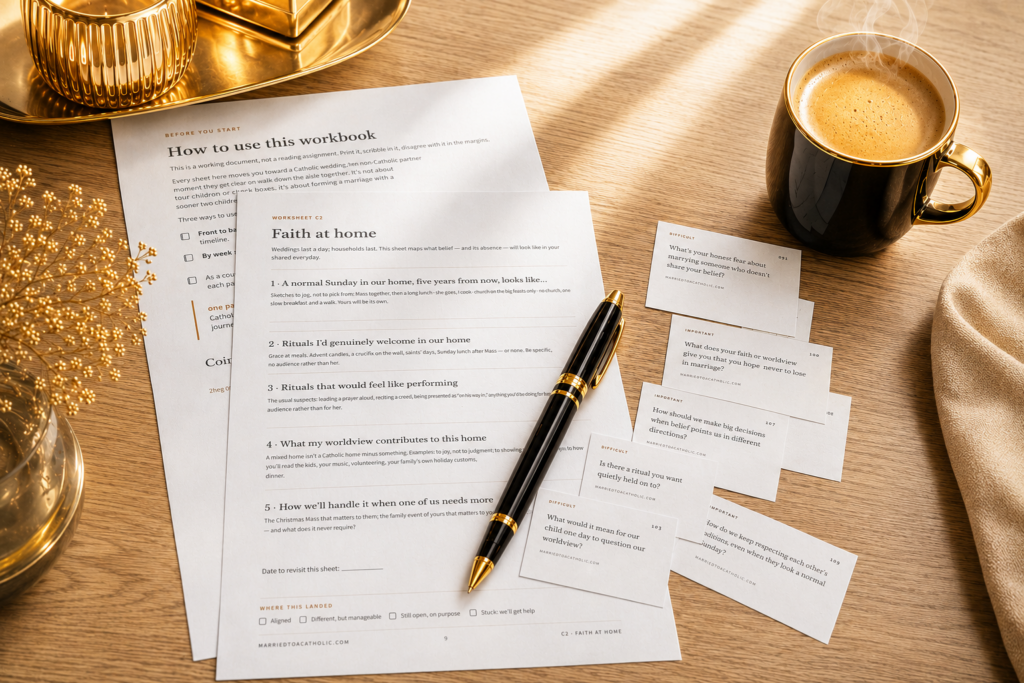
A complete step-by-step system to guide you both through Catholic wedding prep. Includes an 81-page guide, a shared workbook with practical worksheets, and 40 conversation cards.
Talk through your differences today, so you can walk down the aisle completely aligned.
One payment, including tax. 14 days, money back. Read a full chapter free.