
Sooner or later the invitation comes, usually from the mother, usually gently: “Would you like to come to Mass with us on Sunday?” And you understand instantly that this is two tests in one: an hour of unfamiliar liturgy, performed in front of the people whose acceptance matters most. Relax on both counts. The liturgy is choreography you can learn in five minutes, and the family isn’t grading your genuflection. They’re reading something much simpler. Here’s the complete field guide.
What the invitation actually means
Nine times out of ten, it’s not a conversion attempt. It’s inclusion. Mass is where this family exists together weekly; inviting you is inviting you into their ordinary life, the same gesture as “come to Sunday lunch.” Accepting is a gift that costs you an hour. (Declining politely is also allowed, and a partner worth marrying will buffer it, but this guide assumes you’re going, because going, done right, pays dividends for years.)
The choreography: sit, stand, kneel
A Sunday Mass runs about an hour and has a fixed shape: entrance and greeting, readings and a homily (sitting, mostly), the Eucharistic prayer (this is where the kneeling happens), communion, a blessing, done. The single rule that covers ninety percent of it: do what the room does, half a second later. Stand when they stand, sit when they sit. Kneeling is the one exception where you have a choice, guests commonly sit respectfully while the pews kneel, and nobody minds; do whichever feels less like theater.
What you don’t do, ever, because you don’t have to: cross yourself, recite the prayers, sing (though nobody stops a guest who enjoys a hymn), dip fingers in the holy water at the door, or genuflect toward the altar before entering the pew, just step in and sit. Silence during the spoken parts is completely invisible; half the Catholics present are mumbling anyway. If a collection basket passes, a small note dropped in is a gracious touch, not an obligation.
The communion moment
The one stretch where the room physically sorts itself, rows emptying toward the altar, and the moment first-timers dread. Your options, in order of simplicity: stay seated (universally fine, visibly common. You will not be the only one), or, where local custom welcomes it, join the line with arms crossed over your chest to receive a blessing instead. Decide with your partner in the car, before, so the moment has a plan instead of a panic. And know this from someone who has sat through it: nobody is looking at you. Every person in that queue is managing their own moment.
(If your first Mass is going to be your own Nuptial Mass (a higher-stakes version of the same hour) the wedding-specific walkthrough is in the ceremony guide.)
From experience: Nobody warned me about the sign of peace. Mid-Mass, the entire congregation suddenly turns and starts shaking hands, including three strangers and my future mother-in-law, beaming at me. I’d braced for Latin and incense; the thing that nearly broke my composure was surprise cordiality. Consider yourself warned in my place.
The small surprises, catalogued
The sign of peace: at a set point, everyone shakes hands with their neighbors, “peace be with you.” Shake back, smile, say “and with you” or nothing at all. It’s the friendliest thirty seconds in liturgy. Standing for the Gospel: the room rises for one particular reading; follow. The responses: the congregation answers the priest in unison throughout; your silence is expected and unremarkable. Sudden Latin or singing: depends on the parish; treat it as a concert you didn’t buy tickets for. The whole apparatus is far more forgiving of guests than any first-timer believes, churches have been absorbing confused visitors for centuries.
The family around the Mass
The hour in the pew is the easy part; the brunch after is the actual event. Expect a gentle probe or two, “so, what did you think?”, possibly a hopeful “maybe it’ll grow on you.” Have your sentence ready, honest and warm: “It was beautiful. I loved seeing something that matters so much to you all.” True (aesthetically, it usually is), kind, and committing you to nothing. Deflect the growing-on-you line with a smile, not a debate; theological sparring over pancakes is a game with no winners.
Two structural notes. Your partner’s job that morning is buffer, fielding the pointed questions, changing subjects, backing your choices about kneeling and communion without commentary; agree on this beforehand (it’s protocol item one in conversation six). And the grandmother who watches you all Mass with an unreadable expression? She’s usually the one won over first. Devout older relatives tend to read one signal only (he came, he was respectful) and that signal outweighs a decade of theological difference.
“[✎] After my first Mass, her grandmother squeezed my hand and said something in a dialect I barely understood. My wife translated later: ‘He stands nicely.’ I have received worse reviews for greater efforts.”
What you’re actually communicating by going
Here’s the reframe that turns the dreaded hour into a strategic gift: the family cannot read your theology, only your posture. Presence, punctuality, quiet respect: that’s the entire message, and it’s the message they were waiting for. You’re not signaling agreement; you’re signaling that their world will be treated gently in your marriage. That’s also, not coincidentally, the exact reassurance their child needs about you, and if the deeper fears behind this morning are still circling (theirs or yours), they have a guide of their own. One respectful Mass buys more family peace than a hundred perfect arguments. Cheap at the price of an hour’s choreography.
Key takeaways
- The invitation is inclusion, not recruitment, accepting costs an hour and pays for years.
- One rule covers the choreography: do what the room does, half a second later, with kneeling and all spoken parts fully optional for a guest.
- Communion: stay seated (universal, common) or crossed-arms blessing (where customary), decide in the car, together.
- Brunch is the real event: one warm honest sentence ready, partner on buffer duty, no theology over pancakes.
- The family reads posture, not theology, respectful presence is the whole message, and it’s the one they’re hoping for.
IF YOU WANT TO GO DEEPER
The Non-Catholic Partner’s Wedding Kit
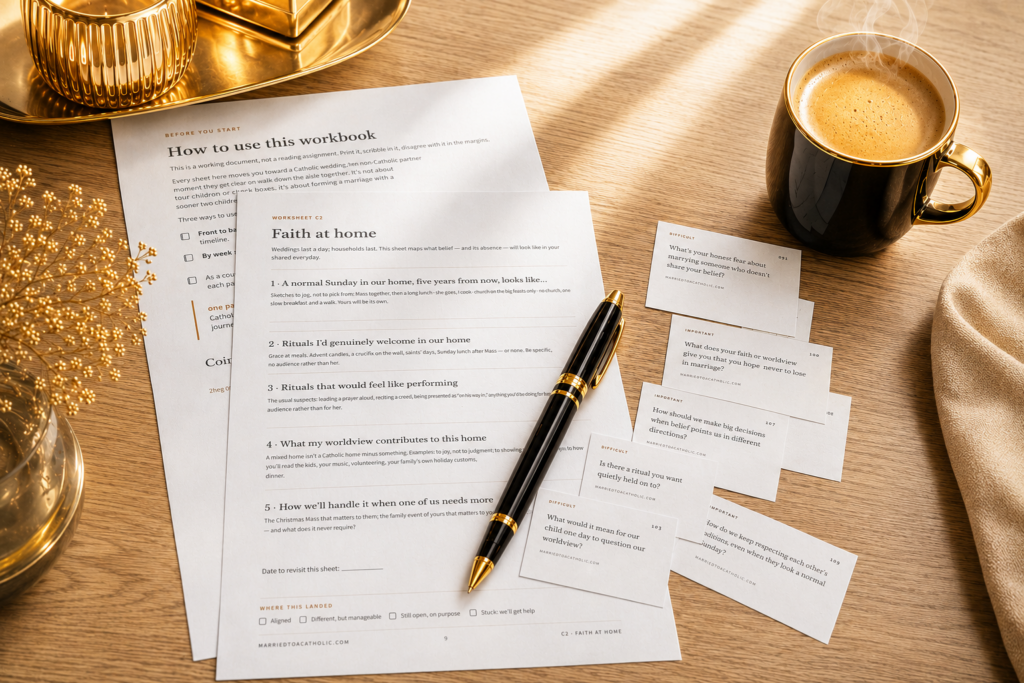
A complete step-by-step system to guide you both through Catholic wedding prep. Includes an 81-page guide, a shared workbook with practical worksheets, and 40 conversation cards.
Talk through your differences today, so you can walk down the aisle completely aligned.
One payment, including tax. 14 days, money back. Read a full chapter free.