
Of every step in the whole process, this is the one non-Catholic partners fear most: sitting across a desk from a priest, waiting to be found out. I spent the car ride there rehearsing defenses of my worldview. I never needed a single one. This guide is the script of that meeting (what he’ll ask you, what he won’t, and what you should ask him) so you can spend your car ride talking about lunch.
What this meeting is, and isn’t
The first visit is booked by your Catholic partner, usually at the parish where they live or grew up, and you go together. Plan for thirty minutes to an hour. Its official purpose is administrative: the priest opens your marriage file, checks the basics, and starts the calendar, because between this meeting and your wedding date, most parishes want six months or more.
Its unofficial purpose is human: he’s meeting a couple, and you’re meeting the man who will marry you. He is not screening you for faith. He has married mixed couples before, statistically, many of them, and your presence in his office is a Tuesday, not a theological event.
The questions he’ll actually ask
To both of you, the couple questions: How did you meet? How long have you been together? When are you thinking of marrying? Have either of you been married before? These aren’t small talk (freedom to marry is the one thing he genuinely must verify) but they’re delivered as small talk, and they’re the bulk of the meeting.
To you specifically, sooner or later: “Were you baptized?” This is the question, and it’s logistics, not judgment: your answer determines which form he files with the diocese, the permission or dispensation that makes the marriage possible. Answer plainly. If you were baptized somewhere long ago, say where; he’ll ask you to request a certificate. If you weren’t, “no” is a complete and unremarkable answer.
And the intent questions, to each of you: Do you intend this marriage to be for life? Exclusive? Are you open to having children? Notice the shape of these. They’re about the marriage you’re building, not the beliefs you hold. Answering them honestly requires no faith at all, only a settled heart about the person next to you.
He’ll also make sure you know about your partner’s declaration and promise. That you’ve been told, which is all the Church requires of you on that front.
From experience: The single question our priest asked about my inner life was “Were you baptized?”, and when I said no, he nodded and asked whether we’d prefer a Saturday. I had prepared, without exaggeration, a defense of deism. It remains undelivered to this day.
The questions he won’t ask
For the record (because the fear of these questions is why this article exists) here is what did not and will not come up.
He won’t ask whether you believe in God. He won’t ask you to explain, justify, or soften your worldview. He won’t ask whether you’d consider converting, and if the topic arises at all, it’s more likely as him reassuring you that it isn’t required. He won’t quiz you on Catholicism; you are allowed to not know what a chasuble is. And he won’t ask you to make any commitment about your future children’s religion. That promise belongs to your partner alone, and the honest conversation about what it means belongs to the two of you at home. [✎ volitelně: jedna věta, co vás nejvíc překvapilo, že nepadlo]
The questions you should ask him
You’re not only there to answer. This is your best early chance to pin down the practical shape of the next six months, and priests generally respect a couple that arrives with questions. Bring these:
Dates: Which dates are realistic for the church, and how firm is the diocese’s minimum notice period?
Preparation: What does marriage preparation look like here: a weekend, evening sessions, meetings with him? When do they run? Paperwork: What exactly should each of us bring to the next meeting? How long does the dispensation typically take in this diocese?
The ceremony: Would he recommend the form without Mass for a couple like you, and what does that look like here?
Money: What is the customary offering for the church, the organist, the flowers?
His answers to the last two will tell you as much about him as about the parish: a priest who lights up explaining the ceremony options is a priest who’ll give you a good wedding.
“[✎] Halfway through, I realized the meeting I’d feared for weeks was mostly a scheduling call with a kind man in a collar.”
If the meeting goes badly
It usually doesn’t. But priests are people, parishes have cultures, and occasionally a mixed couple meets genuine coldness: a lecture instead of a conversation, or pressure that shouldn’t be there. If that happens, know two things. First, the coldness is about that person, not about the rules: nothing in the Church’s own process licenses it. Second, you have options: your partner can generally approach another parish or another priest, and many couples quietly do. A bad first meeting is a reason to change rooms, not to change plans.
And if the meeting goes well but leaves the two of you with bigger questions than it answered (about children, holidays, what this marriage will actually look like) that’s normal, and it’s the useful kind of unsettled. Take it home and take it through the 10 conversations to have before marrying a Catholic.
Key takeaways
- The first visit is administrative and human, not theological: opening the file, checking freedom to marry, starting the calendar.
- The one personal question you’ll get is “Were you baptized?”: logistics that determines a form, not a judgment.
- The intent questions (for life, exclusive, open to children) are about marriage, not God: an honest non-believer can answer every one.
- No question about belief, conversion, or your children’s religion is coming. Prepare your defense speech and enjoy never giving it.
- Arrive with your own questions: dates, prep format, documents, ceremony form, customary costs, and leave with the next six months mapped.
IF YOU WANT TO GO DEEPER
The Non-Catholic Partner’s Wedding Kit
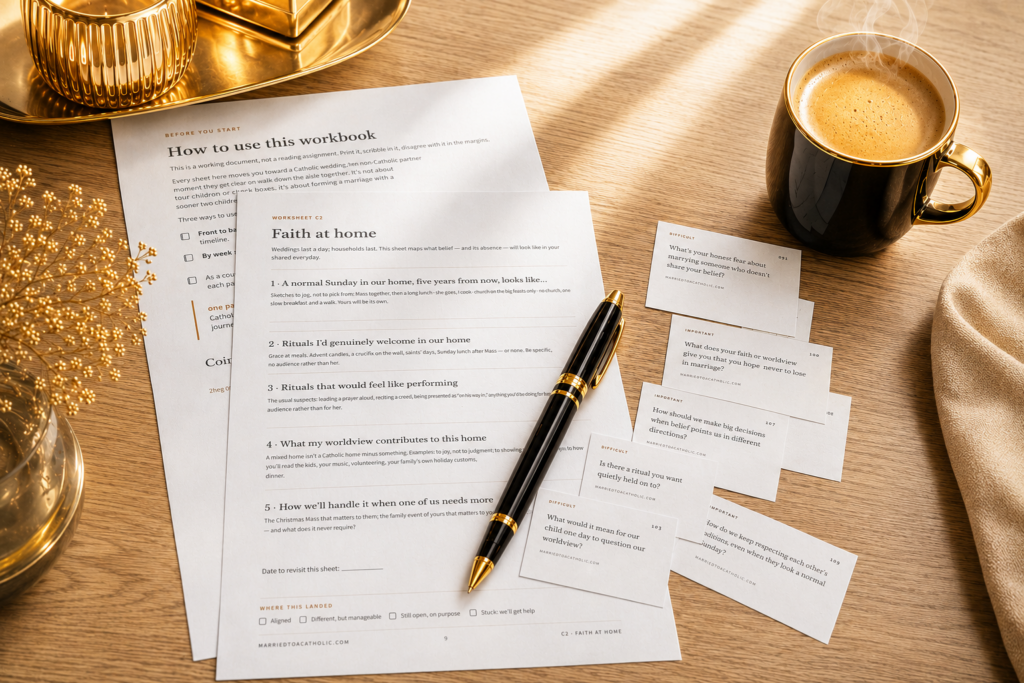
A complete step-by-step system to guide you both through Catholic wedding prep. Includes an 81-page guide, a shared workbook with practical worksheets, and 40 conversation cards.
Talk through your differences today, so you can walk down the aisle completely aligned.
One payment, including tax. 14 days, money back. Read a full chapter free.