
The church paperwork for a mixed marriage takes about an afternoon. I know, because I’ve mapped every step of it. The conversations behind that paperwork took us months, and they were worth every evening. This is the list I wish someone had handed me: ten conversations to have with your Catholic partner before the wedding, each with the question that opens it.
A word on how to use this list. Not in one sitting: these are ten walks, ten dinners, ten drives. Not as an interrogation. You’re building a marriage, not deposing a witness. And not with the goal of agreement on everything today; the goal is that nothing on this list surprises either of you after the wedding. Surprise, not difference, is the enemy.
1. The children: before anyone signs anything
During the paperwork, your partner will promise to do all in their power to have your children baptized and raised Catholic. That promise binds them, not you, but the life it describes will be lived by both of you, and by people who don’t exist yet. Baptism, yes or no? Religious education? What will you say when a seven-year-old asks why daddy doesn’t take communion? This is the biggest conversation on the list, which is why it has a full guide of its own. Opener: “Walk me through a Sunday morning in our house, ten years from now.”
2. What the faith actually means to them
“Catholic” spans everything from daily Mass to Christmas-and-funerals. You probably know your partner’s habits, but habits aren’t the whole story, especially for someone raised in the faith. Is this identity, obligation, comfort, conviction? What would they miss if it vanished? You can’t navigate a thing you’ve never had described to you from the inside. Opener: “Tell me about a moment your faith actually mattered to you, not church, faith.”
3. The church wedding, whose need is it?
Sometimes the church wedding is the partner’s deep wish. Sometimes it’s their mother’s. Those are different marriages to different expectations, and it’s far better to know which one you’re in. If it’s your partner’s own need, honor it fully. If it’s family pressure they’re passing along, that’s not a reason to refuse, but it is a reason to talk about how the two of you will handle family pressure generally, because this won’t be its last appearance. Opener: “If your parents didn’t exist, would we still be getting married in a church?”
4. Your “no”: the things you won’t do
You’re doing a lot: the meetings, the prep course, the ceremony. Somewhere there’s a line you won’t cross: pretending to pray, taking communion to blend in, letting relatives assume you’re converting. Your partner can only defend a line they know about. Draw it out loud, kindly, and early, because a boundary stated at the engagement is a preference; the same boundary stated at the altar is a scene. And for the record on the biggest one: conversion is not required, ever. Opener: “Here’s what I can do wholeheartedly, and here’s what I can’t do honestly.”
From experience: We had conversation four twice: once badly, at midnight, mid-argument, and once well, on a long drive with nowhere to storm off to. The list works much better as a road trip than as an ambush. Pick your moments like you’d pick them for any negotiation that matters.
5. The home you’ll build: holidays, rituals, walls
Marriage turns abstractions concrete: Midnight Mass or midnight movie? Grace before meals? A crucifix in the living room, and whose living room is it, anyway? None of these is large alone; together they’re the daily texture of a mixed home. The happiest couples I’ve encountered treat this as curation, not conquest: each keeping what’s meaningful, dropping what’s mere default. Opener: “Which three traditions from your childhood do you actually want in our house, and which were just there?”
6. The devout family, and who defends whom
Your partner’s family may be relaxed, or may be praying novenas for your conversion. Either way, agree on the protocol before the first big test: who answers grandma’s pointed question, what your partner says when you’re not in the room, and what backup looks like when you’re the only one at the table not crossing yourself. (For the practical side of that table: the sit-stand-kneel of it, there’s a field guide to your first Mass with the family.) Opener: “When your mother asks if I’m converting, what exactly will you say?”
7. Family planning: the quiet doctrine in the bedroom
Catholic teaching on contraception is real, and Catholics relate to it across the whole spectrum, from full observance to quiet disagreement. You need to know where your partner actually stands, not where the catechism stands, because this conversation lives in your bedroom, not the parish office. It’s also the one couples most reliably skip out of embarrassment, which is exactly why it makes the list, and why it gets its own honest guide. Opener: “What did you grow up believing about this, and what do you believe now?”
8. If faith grows, or fades
You’re marrying today’s person, but faith moves over a lifetime: your partner may drift from the Church, or plunge deeper after a crisis or a child. So might you, in either direction. You can’t pre-negotiate the future, but you can agree on the constitution for it: we tell each other when something shifts, and neither of us treats the other’s movement as betrayal. Opener: “What would you want from me if you lost your faith? And if I found one?”
9. Money, time, and the parish
Faith has a budget line and a calendar line: donations, collections, perhaps tithing; Sunday mornings, feast days, maybe volunteering. Small numbers, but shared accounts and shared weekends make them joint decisions, and few things corrode quietly like one partner discovering the other’s standing order to the parish, or losing every Sunday morning without ever being asked. Opener: “What does the Church get from our household, money and hours, and are we both signing off on it?”
10. The fears nobody says out loud
Yours might be: pressure to convert arriving years from now, wearing you down decade by decade. Or being a guest at your own wedding. Or the fine print of the end: a Catholic funeral you never agreed to. Your partner has a mirror list: that you’ll resent the Church forever, that you secretly think their faith is childish. These fears do their damage in the dark, and almost all of them shrink in daylight. Say yours; ask for theirs. The most common ones, and what became of them in real marriages, are collected in the fears nobody says out loud. Opener: “What’s the worst-case version of us that quietly worries you?”
“[✎] Ten conversations sounded like therapy homework. In practice it was six good dinners, two long drives, one argument, and one conversation that turned out to be the reason we’re solid today.”
And if a conversation goes wrong?
Most of these talks end closer than they began. That’s the norm, and disagreement itself is not failure. But if a conversation reveals something harder (a partner who won’t discuss any of it, promises made on your behalf without you, family demands your partner won’t buffer), take it seriously rather than romantically. The difference between a rough patch and a real warning sign is its own topic: when it’s more than cold feet.
IF YOU WANT TO GO DEEPER
The Non-Catholic Partner’s Wedding Kit
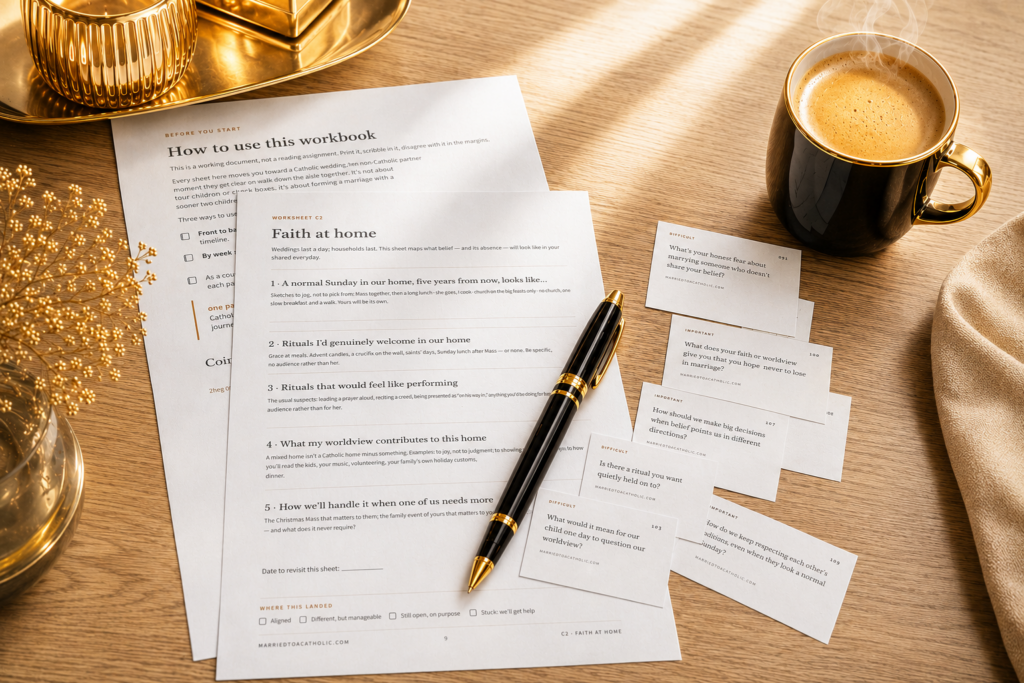
A complete step-by-step system to guide you both through Catholic wedding prep. Includes an 81-page guide, a shared workbook with practical worksheets, and 40 conversation cards.
Talk through your differences today, so you can walk down the aisle completely aligned.
One payment, including tax. 14 days, money back. Read a full chapter free.
Key takeaways
- Surprise, not difference, is the enemy: the goal is that nothing on this list ambushes either of you after the wedding.
- The big three: children, your “no”, and the fears, if you only manage three conversations, make it those.
- Every conversation needs an opener, not an agenda: one honest question beats a checklist recited at dinner.
- Agree on protocol for the outside world: who answers the family’s questions, and who defends whom.
- Spread it out, ten talks over months, not a summit over one exhausting weekend.