
If you’re the kind of person who reads a contract before signing it (and marrying into a two-thousand-year-old institution, you should be) this guide is your document inventory. Every paper in a Catholic mixed-marriage file, sorted into three piles: what your Catholic partner signs, what you sign, and what nobody will ever put in front of you. The third pile is the one the rumors are about.
One framing note before the inventory: the file belongs to the parish, the process is run by the priest, and most of the paperwork burden falls on your partner: the Catholic. Your own stack is thin. Where this fits in the overall journey is mapped in the complete process guide; here we zoom in on the papers themselves.
Pile one: what your Catholic partner signs
A recent baptism certificate. Not the framed one from their childhood bedroom. Parishes often want a freshly issued copy, because the Church records sacraments (confirmation, prior marriages) as annotations on the baptismal record. A phone call to their childhood parish handles it.
The prenuptial inquiry. A structured questionnaire the priest completes with each of you: identity, freedom to marry, and intent: permanence, fidelity, openness to children. Your partner answers and signs their half.
The declaration and promise. The centerpiece of the mixed-marriage file, and the document people mean when they say “the promises.” Your partner declares they intend to remain Catholic, and promises to do all in their power to have children baptized and raised Catholic. Their signature. Their promise. Not yours: a distinction unpacked fully in Do I have to convert to marry a Catholic?
The request for permission or dispensation technically sits in this pile too, though nobody signs it at your kitchen table: the priest drafts it, the diocese grants it, the file absorbs it. The full anatomy of that form is in The dispensation explained.
Pile two: what you sign
Your half of the prenuptial inquiry. The same factual questionnaire your partner answered: who you are, that you’re free to marry, that you intend a permanent and faithful marriage open to children. Read those questions carefully and you’ll notice what’s missing. There is no question about God. You’re signing statements about your marriage, not your metaphysics.
An identity document, and possibly a birth certificate. If you were never baptized, your birth certificate typically stands in where your partner’s baptism certificate stands. If you were baptized in another tradition, a baptism certificate from that church joins the file instead.
Proof of freedom to marry. In some countries this means short affidavits: a parent or long-time acquaintance attesting you’ve never been married. It sounds quaint because it is; it predates searchable records and survives on institutional momentum.
Possibly: an acknowledgment. Some dioceses ask the non-Catholic partner to sign that they have been informed of the Catholic partner’s promise. Read it before signing, as you would anything, and notice the verb. You’re confirming you know about a promise. You are not making one.
The civil paperwork. Whatever your country requires (a marriage license, a civil registration) runs alongside the church file. That’s the state’s stack, not the Church’s, and it’s identical to what any couple at city hall would sign.
From experience: My entire contribution to the church file was a birth certificate and about twenty minutes of questionnaire. The civil registry, by contrast, wanted three documents, two visits, and a fee. The institution I’d expected to bury me in paperwork was the more efficient of the two.
Pile three: what nobody will ask you to sign
This pile matters most, because it’s the one your imagination, or someone’s grandmother, has been filling in. For the record, the mixed-marriage file contains none of the following.
No promise about your children’s religion. The promise exists, but it’s your partner’s signature and it commits your partner’s effort, which is precisely why the real decision lives in your conversations at home, not in the file. What that promise turns into in daily family life is its own big topic: Children: what “raised Catholic” will actually mean in your home.
No profession of faith. There is no document, in any Catholic diocese anywhere, that asks the non-Catholic partner to affirm belief in God as a condition of marriage.
No conversion paperwork. Conversion has its own, entirely separate, entirely voluntary process, and nothing in the marriage file enrolls you in it or commits you to it later.
If anything is ever placed in front of you that seems to belong to this pile, don’t sign it in the moment. Take it home, read it, ask. In years of listening to couples’ stories, every case I’ve encountered dissolved into a misunderstanding of an acknowledgment form. But your signature is yours, and “I’d like to read this first” is a complete sentence, even in a parish office.
“I came home from the paperwork meeting and my mother asked what I’d had to sign away. I read her the questionnaire. She was quiet for a moment and then said: that’s less than your phone contract.”
One practical habit: keep copies
The parish keeps the file, and that’s normally the last you’ll hear of it. Still, photograph or scan everything you and your partner sign, the day you sign it. Not out of distrust, but out of the same habit that makes you keep the boiler warranty. If you ever move countries, transfer parishes, or (for future readers of the convalidation guide) need to prove the marriage’s church status, those copies turn a months-long records hunt into an email attachment.
Key takeaways
- Three piles: your partner’s (baptism certificate, inquiry, the declaration and promise), yours (inquiry, identity documents, possibly an acknowledgment), and the one that doesn’t exist.
- Everything you sign states facts and intentions about marriage: permanence, fidelity, children. Nothing you sign concerns belief.
- An “acknowledgment” that you know of your partner’s promise is not a promise of your own: the verb is the whole document.
- No profession of faith, no conversion enrollment, no signature about your children’s religion will ever be asked of you.
- Scan everything on signing day: future-you, possibly in another country, will be grateful.
IF YOU WANT TO GO DEEPER
The Non-Catholic Partner’s Wedding Kit
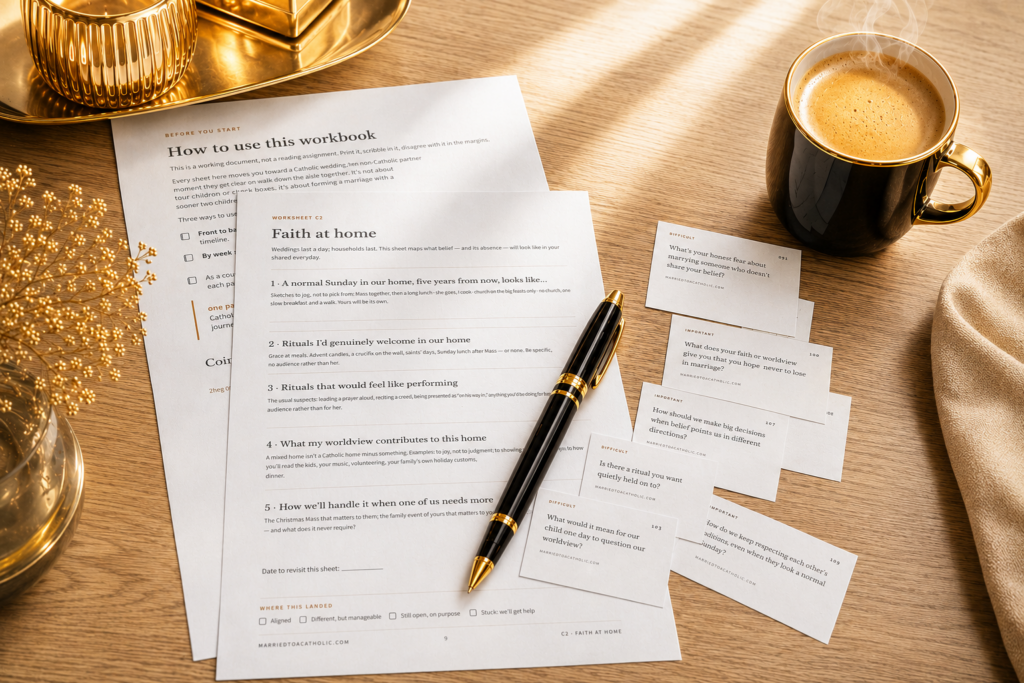
A complete step-by-step system to guide you both through Catholic wedding prep. Includes an 81-page guide, a shared workbook with practical worksheets, and 40 conversation cards.
Talk through your differences today, so you can walk down the aisle completely aligned.
One payment, including tax. 14 days, money back. Read a full chapter free.