
For couples not marrying in the Church
The paperwork got simpler.
The questions did not go away.
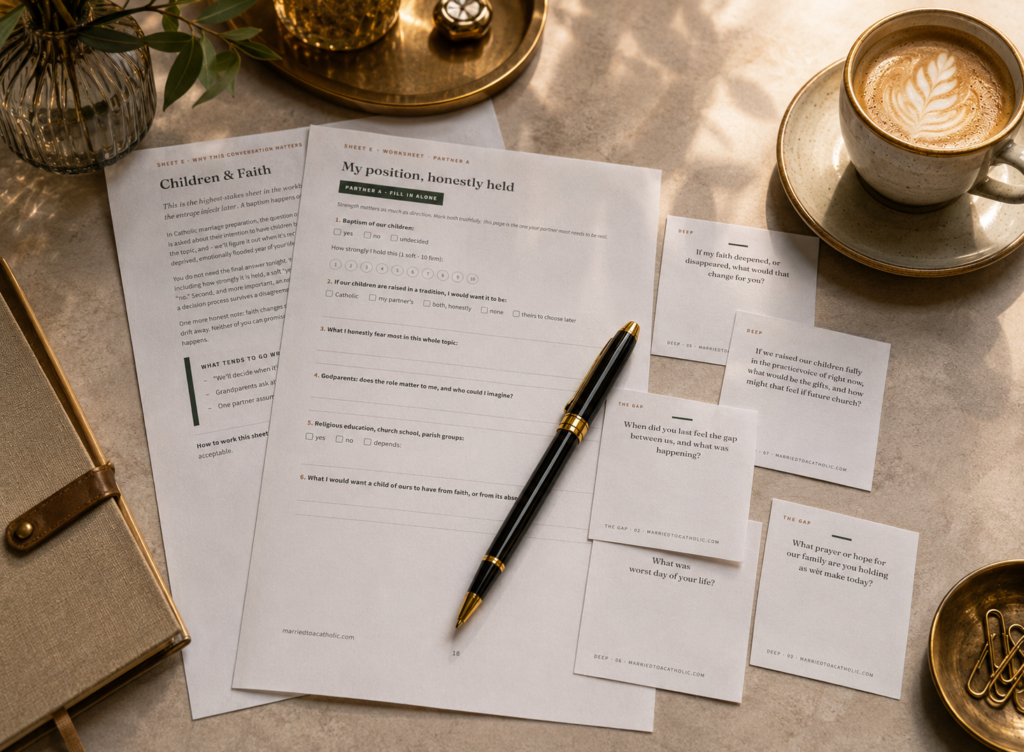
Skipping the Church, Not the Conversations is a marriage preparation workbook for couples where at least one partner is Catholic and the wedding will not be in the Church.
- Ten worksheets. One subject each, faith to the long view.
- 36 conversation cards. Four decks, one of them about the difference in faith between you.
- 49 pages. Printed at home, in A4 or US Letter.
$19One payment, including tax. For both of you. Yours to keep.
Instant download. 14 days, money back, no questions asked.
Read a full sheet first, free, no email required.
Nobody is going to make you have these conversations
Marry in the Catholic Church and marriage preparation is not optional. Marry anywhere else, a courthouse, a garden, a mountain, and nobody prepares you at all.
The value was never the certificate. It is that a process puts a set of easily postponed subjects on the table and does not move on until they have been discussed: faith, children, money, conflict, intimacy, both families, the years after the wedding. Two people sit down on a Saturday and, sometimes for the first time, hear what the other one actually thinks.
Skip the course and the paperwork gets simpler. The topics do not disappear. Only the appointment does. There is no Saturday, no form, nobody asking, and no natural evening on which the two of you sit down and work through the list.
This workbook is that appointment. Ten sheets, one subject each, at your own table and at your own pace. Every sheet opens with a page on why the conversation matters and what tends to go wrong when it is skipped.
If any of this sounds familiar, it was built for you
- “We will work out the children question when it is actually real.”
- One of you still goes to Mass sometimes, and neither of you has said out loud what that is going to look like in a shared home.
- Both families have opinions about the wedding, and the two of you have not agreed on a single sentence to answer them with.
- Nobody has asked what a christening, a funeral, or a Christmas Eve is supposed to look like in your household.
- Money has been discussed in general terms and never in numbers.
None of that means something is wrong with the two of you. It means nobody has sat you down, and nobody is going to.
What you get
PDF · 49 pages
Ten worksheets
Faith, the wedding decision, family pressure, traditions and the calendar, children, money, home and work, conflict, intimacy and family planning, and the long view. One subject per sitting, in an order that starts where it has to start.
PDF · print or phone
36 conversation cards
Four decks for the evenings when a worksheet is too much: light, medium, deep, and one deck aimed straight at the difference in faith between you. Cut them out, or read them off a phone on a long drive.
Included
One honest page
A plain statement of what the Church holds about a marriage outside it: canonical form, the dispensation that exists only for some couples, and convalidation as a door that stays open. Stated once, without a verdict on your decision, and then closed.
Both paper sizes are in the download, A4 and US Letter. Print the one that matches your paper.
The ten conversations
- A. Faith Snapshot. Where each of you actually stands, as against what the labels have said since the day you met.
- B. The Wedding Decision. Whether the two of you made it, or one of you made it and the other let it happen.
- C. Family & Pressure. The reaction a wedding outside the Church produces, and one answer the two of you give together instead of two answers improvised in hallways.
- D. Traditions & the Calendar. Advent, Christmas Eve, Easter, name days, and whose year the two of you are going to live in once you have your own household.
- E. Children & Faith. Baptism, upbringing, and an agreed way of deciding if you still disagree when a child is actually on the way. The workbook calls this its highest stakes sheet.
- F. Money & Generosity. Everything owed and owned, who decides what and above which amount, and where giving fits, including giving to a parish.
- G. Home, Roles & Work. The household each of you grew up in and is quietly still running on, plus whose career leads when the two of them collide.
- H. Conflict & Repair. How each of you fights, how each of you repairs, and which arguments are the difference in faith wearing a different coat.
- I. Intimacy & Family Planning. Expectations, contraception, timing, and the conversation about infertility that most couples have for the first time inside the crisis itself.
- J. The Long View. Illness, funerals, ageing parents, and what each of you would want in the week nobody wants to be guessing.
Three of the ten are worked together from the start. The other seven give each of you your own page.
Why not just a book of couple questions
There are good ones, and if one is already on your shelf, use it. But here are three things this workbook does that a general book cannot.
It covers the ground a marriage preparation course covers. Not a pleasant assortment of questions, but the list a process built over decades insists a couple works through before a wedding. Whatever you make of where that list came from, it is a serious list, and it was assembled by people who have watched a great many marriages up close.
The difference in faith between you is the subject, not an aside. A general book cannot ask what the first married Christmas looks like when one of you still goes to Mass and the other does not, or what a grandmother’s expectation about a baptism does to a marriage, or which of your recurring arguments are really about faith under another name. It runs through every one of the ten sheets, and one of the four card decks is built for nothing else.
Most sheets give each of you your own page, filled in before either of you speaks. Writing first has one purpose. It stops the faster talker from setting the answer for both of you, which is the whole difference between an honest first answer and a diplomatic one.
Who this is for, and who it is not
It is for
- Couples where at least one partner is Catholic and the wedding will not be in the Church: a civil ceremony, another tradition, a garden, a courthouse.
- Two Catholics with very different depths of faith between them, which is its own kind of mixed couple.
- Couples who are already married and never had these conversations. The sheets do not expire, and the workbook ends by asking you to reopen it.
It is not
- Canonical, legal, or pastoral advice. On anything specific to your situation, a parish or a lawyer has the final word, not a workbook.
- A case for or against marrying in the Church. It argues for the conversations and for nothing else.
- A substitute for the Church’s own marriage preparation. If you ever pursue convalidation, the parish may ask you to complete that preparation then.
- An official Church resource. This is independent, and not affiliated with, endorsed by, or written on behalf of the Catholic Church, any diocese, or any parish.
Who wrote this
I am Petr, a non-Catholic engaged to a Catholic, and we are marrying in the Catholic Church. Which means I am going through the Church’s marriage preparation as I write this, and that the difference in faith these sheets ask about is one I am living rather than describing from a distance.
The preparation turned out to be more useful than I expected, and not for the reason it formally exists. The value was never the certificate at the end. It is that the process puts a set of easily postponed conversations on the table and does not move on until they have happened: faith, children, money, conflict, intimacy, both families, the long view. That is a good list by any standard, and working through it before a wedding rather than years into a marriage is a real advantage.
A couple marrying anywhere else gets the simpler paperwork and none of that list. Working through those questions is how two people find the points where they quietly disagree, and finding them at a kitchen table months before a wedding, with time on your side and nobody waiting on an answer, is a completely different evening from finding them years afterwards.
So this workbook takes the ground that preparation covers and reshapes it for two people who will not be sitting in that hall. It takes no position on where you marry. That decision is yours and it may well be the right one. The only position here is that these conversations are worth having either way.
If it is not what you needed
Fourteen days, money back, no questions and no explanation required. Write to info@marriedtoacatholic.com and you get a refund.
If you have a minute beyond that, I would be glad to hear what it got wrong. A refund with a reason behind it is worth more to me than a sale.
Questions people ask before buying
What format is it, and how do I get it?
PDFs, delivered by email the moment you buy. The workbook comes twice, once sized for A4 and once for US Letter, and the conversation cards are inside it. Print the version that matches your paper, at home, in black and white if you prefer.
We are both Catholic. Is this for us?
Yes, and it may matter more in your case. Two Catholics can sit at very different depths of faith without ever having measured the distance. The sheets ask rather than assume, so they work whatever the mix. One thing the honest page states plainly: where both partners are Catholic, the Church will not dispense from its required form beforehand, which is a difference worth knowing before the wedding rather than after.
Are you trying to talk us into a church wedding?
No. What the Church holds is stated once, on one page, without a verdict on your decision, and then the subject is closed. There is no apologetics in this workbook and no sneering at belief either. It argues for the conversations and for nothing else.
We are already married. Is it too late for this?
No. Most of the sheets read the same after a wedding as before one, and the workbook is written to be reopened rather than filed away. The wedding decision sheet is the one that lands differently once the day has passed, which is worth knowing before you buy rather than after.
What if we later want the Church to recognise our marriage?
Convalidation exists, it is often simpler than people expect, and two of the sheets return to it, because how each of you feels about that door is worth knowing now rather than in the middle of deciding. This is not a guide to that process. For the process itself, your parish is the place to start.
Do we have to print it?
It is designed to be printed, single sided, with two pens, so that each of you can physically hold your own page. It also works from a screen with two notebooks, and the cards can be read straight off a phone.
What about tax, and what currency is this?
The price is in US dollars, and that is what you pay. Any VAT or sales tax is already included and is handled by Gumroad, which acts as merchant of record. You will receive a proper invoice if you need it.
The appointment nobody is going to schedule for you
These subjects arrive in a marriage either way: a baptism, a Christmas, a hospital corridor, a number that had never been said out loud. The only real question is whether the two of you get to them first, calmly, at your own table, while they are still hypothetical.
$19Ten worksheets and 36 cards. One payment, tax included.
Instant download. 14 days, money back, no questions asked.
Marrying in the Catholic Church after all? The Non-Catholic Partner’s Wedding Kit is built for that road.